Laser Marking vs. Laser Engraving for Metal Tags: Why Marking Is Often a More Efficient Choice
Laser Marking or Laser Engraving? Choosing the Right Process for Metal Tags
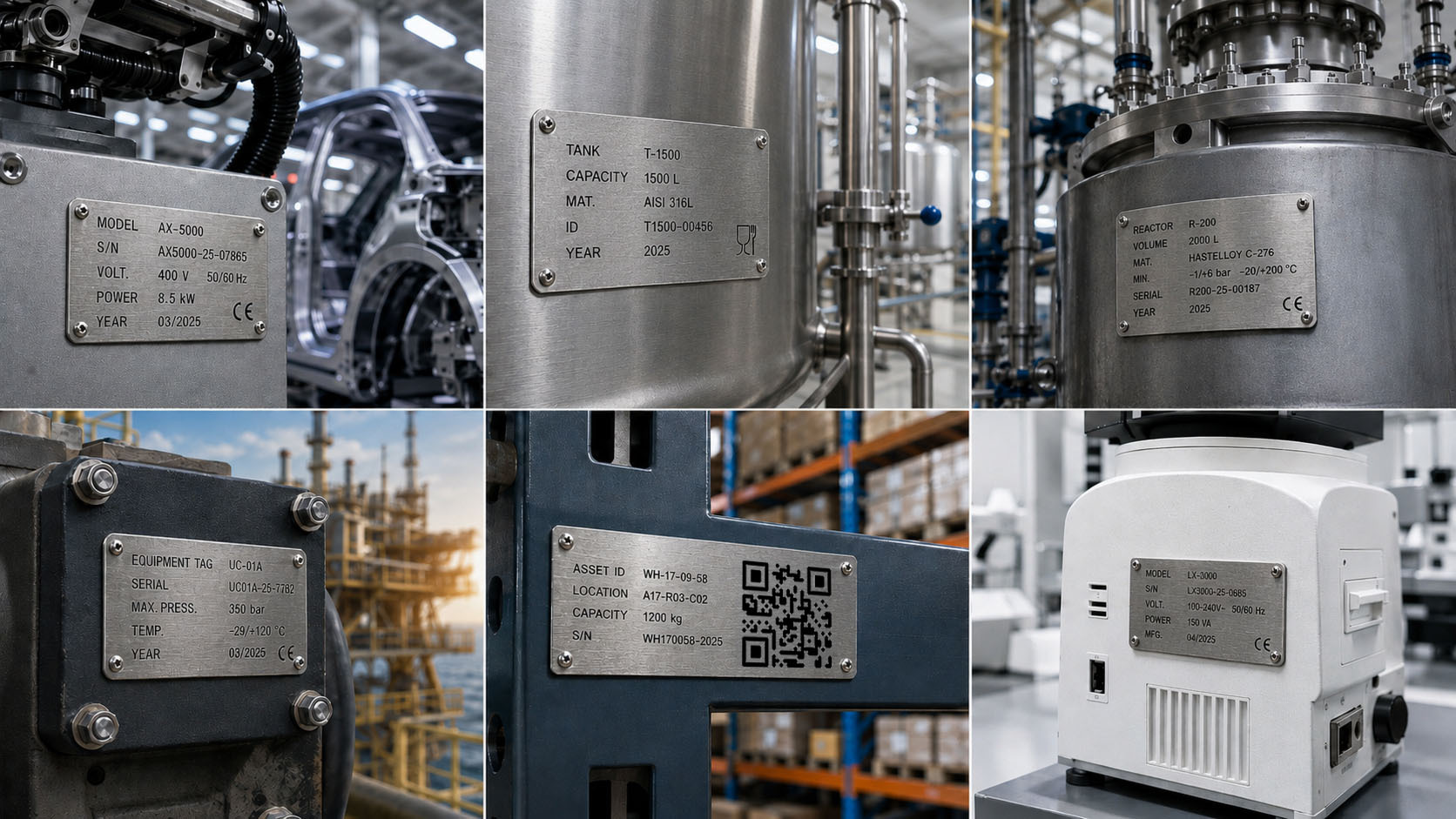
In industrial identification, metal tags carry critical data: serial numbers, QR codes, Data Matrix codes, technical specifications, lot references, and safety information. They must be legible, durable, and produced consistently — often at high volume and in demanding environments.
Two technologies dominate the conversation when it comes to customizing metal tags: laser marking and laser engraving. The terms are frequently used interchangeably. They shouldn't be.
What Is Laser Marking on Metal Tags?
Laser marking is a non-contact process that uses a focused laser beam to alter the surface of a metal without removing material. Depending on the metal and laser parameters, the beam triggers oxidation, annealing, or color change — producing a permanent, high-contrast mark that is smooth to the touch.
On metal tags and nameplates, laser marking is used to apply:
- Serial numbers and part numbers
- QR codes and Data Matrix codes
- Barcodes
- Company logos
- Technical data and specifications
- Traceability references and lot codes
- Safety symbols and regulatory markings
The result is a clean, precise, permanent mark — with no consumables, no inks, and no physical contact with the workpiece.
What Is Laser Engraving and When Does It Make Sense?
Laser engraving uses the laser beam to physically remove material from the surface, creating a deeper mark that is perceptible to the touch. The depth typically ranges from 0.005 to 0.075 inches (0.13 to 1.90 mm), depending on the material and settings.
Engraving is a valid choice in specific contexts — when extreme mechanical resistance is required, or when marks need to remain legible after heavy abrasion, aggressive surface treatments, or repeated mechanical stress. Automotive foundries and casting plants, for example, often use engraving at the start of the manufacturing process precisely because those parts will undergo shotblasting, e-coating, or other finishing steps.
For serial production of industrial metal tags, however, engraving has real limitations. Removing material takes more time, more energy, and requires tighter parameter control. When the priority is consistent quality at volume, those constraints add up.
Why Laser Marking Has the Edge for Industrial Metal Tags
1. Speed — and What It Means at Scale
Because no material is removed, laser marking is significantly faster than engraving. For companies that produce metal tags in batches — or that need to personalize each piece with variable data such as serial numbers, QR codes, or Data Matrix codes — cycle time matters. A few seconds saved per tag compounds quickly across a production run.
High-volume manufacturing environments consistently favor laser marking for this reason: speed and automation compatibility are non-negotiable when throughput is the priority.
2. Code Readability: Sharp Contrast, Clean Edges
Industrial metal tags need to be read reliably — by human operators and by automated scanners alike. Laser marking produces high-contrast marks with well-defined edges, even on small surfaces.
This is critical for QR codes, Data Matrix codes, and barcodes, where contrast quality directly determines scan rates. A mark that looks clean to the eye but fails under a scanner is not a usable mark. Laser marking consistently delivers the contrast and resolution that machine-vision systems require, even in challenging ambient conditions.
3. No Contact, No Stress on the Material
Laser marking applies no physical pressure to the tag. That eliminates the risk of deformation, warping, or unintended surface alteration — particularly relevant for thin tags or materials with tighter tolerances.
In traceability systems where every tag must be not just marked but individually identifiable and scannable, surface integrity is not optional.
4. Full Tag Marking Without Pre-Printing
One advantage that is often overlooked: with laser marking, the entire tag — fixed content and variable data alike — can be produced in a single pass, directly on blank metal stock. No pre-printing required.
Traditional workflows often involve a two-step process: tags are first pre-printed with fixed elements (logos, borders, standard symbols, regulatory text) using silkscreen or pad printing and then marked with variable data in a second step. That means managing printed tag inventory, dealing with minimum order quantities, and accepting the rigidity of a fixed pre-print when specs or layouts change.
Laser marking eliminates that dependency. A blank metal tag enters the system; a finished, fully marked tag comes out. Fixed and variable content are produced in the same operation, using one digital file. Layout changes, new logo versions, or updated regulatory text require no new pre-printed stock — just a file update.
For manufacturers, handling multiple product lines, frequent revisions or low-to-medium batch sizes, this represents reduced inventory, faster turnaround, and significantly more operational flexibility.
5. No Consumables, Lower Operating Costs
The laser marking process requires no inks, solvents, or replacement materials to produce quality marks. This simplifies operational management and reduces long-term costs. The mark becomes part of the material — resistant to abrasion, chemicals, solvents, and heat exposure.
For quality and traceability applications in regulated industries, that permanence is a compliance asset, not just an operational convenience.
Frequently Asked Questions
What is the difference between laser marking and laser engraving?
Laser marking alters the surface of a metal through oxidation or annealing, producing a permanent high-contrast mark without removing material. Laser engraving physically removes material to create a deeper, tactile groove. Marking is faster and better suited to high-volume serial production; engraving is preferred when marks must survive extreme mechanical stress or aggressive post-processing.
Is laser marking permanent on metal?
Yes. A properly configured laser mark is part of the material itself. It resists abrasion, UV exposure, chemical contact, solvents, and extreme temperatures — making it suitable for lifetime identification in demanding industrial environments.
Which process is better for QR codes and Data Matrix on metal tags?
Laser marking is generally preferred. It produces the high-contrast, sharp-edged marks that automated scanners require for reliable reading. The non-contact process also ensures surface integrity is maintained across every tag in a production run.
Does laser marking require consumables?
No. Unlike inkjet or labeling systems, laser marking requires no inks, solvents, or replacement materials. The laser modifies the surface directly, keeping operational costs predictable and maintenance requirements low.
Can laser marking replace silkscreen or pad printing on metal tags?
Yes, in most industrial tag applications. Laser marking can apply both fixed content (logos, borders, standard symbols) and variable data (serial numbers, QR codes) in a single pass on blank metal stock. This eliminates the need for pre-printed tag inventory and the constraints that come with it — minimum order quantities, lead times, and inflexibility when layouts or specifications change.
When should I choose laser engraving over laser marking?
When the application requires extreme depth — for example, when tags are subjected to shotblasting, heavy abrasion, or aggressive surface treatments after marking. In those cases, the additional depth of an engraved mark can be the difference between a readable and an unreadable tag.
The Operational Bottom Line
Choosing between laser marking and laser engraving is not an aesthetic decision. It is an operational one — with direct implications for throughput, traceability, scan reliability, and cost per unit.
For most industrial metal tag applications — serial numbers, QR codes, compliance markings, technical data plates — laser marking delivers the best balance of speed, quality, and process sustainability. Laser engraving remains the right call in specific, high-stress scenarios where depth is required from day one.
Talk to a CIM Technical Expert
Every marking application is different. Material type, tag dimensions, required mark depth, scanning environment, production volume, and downstream treatments all affect which process — and which system — is the right fit.
The CIM technical team analyzes your specific application and identifies the solution that meets your requirements. No generic recommendations. No oversized systems for straightforward jobs. Just a direct technical assessment based on what you actually need.
Request a consultation — our experts will get back to you.